

The inference economy: why enterprise AI is moving closer to the data
July 22, 2026What if the biggest cost of AI isn't AI at all?
For years, the AI conversation was dominated by bigger models, faster accelerators, and larger training environments. The assumption was simple: centralize the data, run the models, and the insights will follow.
But as AI moves to real-world operations, many organizations are discovering a different reality. The challenge is not always creating intelligence. It is delivering intelligence where it can actually make a difference.
Every day, factories, retail stores, telecommunications networks, and remote facilities generate enormous volumes of information. Cameras capture video, sensors monitor equipment, and applications produce a constant stream of operational data. Most of that information is routine, yet it must still be transported, stored, protected, and analyzed.
Increasingly, organizations are realizing that the hidden cost of AI is not just compute. It is moving data.
The business doesn't care about data. It cares about decisions.
Imagine a modern manufacturing plant. Thousands of products move through production every hour while cameras and sensors inspect, monitor, and measure every step of the process. Millions of data points may be generated every day, but the business is not interested in collecting data for its own sake.
What matters is finding the one defect that could impact quality.The same principle applies everywhere. Retailers want to know when shelves are empty. Telecommunications providers need to spot network problems before customers notice. Transportation operators want to identify equipment issues before delays occur.
The value is not in the data itself. The value is in the moment a decision is made.The next era of AI will be defined by inference, not training
Training models remains important, but it is only part of the story.
The real business value of AI is created during inference, when a model analyzes new information and helps an organization act. That could be identifying a quality issue, predicting a failure, detecting a security risk, or improving a customer experience.
In other words, intelligence generates value when it is used, not when it is created. That is why so many organizations are rethinking where AI runs. Instead of sending every piece of data to centralized infrastructure, they are increasingly bringing AI closer to where the data is generated.
Not because it is trendy. Because it makes economic sense.AI factories create intelligence. The edge puts it to work.
The future of enterprise AI is not a single location where all intelligence lives.
Centralized infrastructure will continue to play a critical role in training, refining, and optimizing models. These environments act as AI factories, producing the intelligence that powers modern applications.
But intelligence has to travel beyond the factory. It has to reach the factory floor, the retail store, the network edge, and the remote operational site where decisions are actually made.
That is where edge infrastructure becomes essential.
Think of it as a network of AI micro factories. Instead of transporting vast amounts of raw data back to a central location, enterprises can process information closer to where it is created and act on insights in real time.Bringing intelligence to where business happens
This shift creates new infrastructure requirements. Many edge locations do not have the luxury of dedicated data center space, abundant power, on-site IT resource or even air conditioning. They require platforms specifically designed for distributed environments while still delivering enterprise-grade performance, reliability, and security.
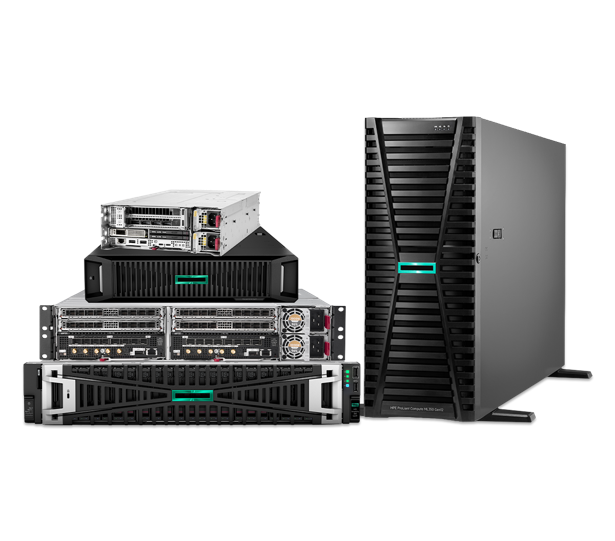
The HPE ProLiant Compute EL2000 is purpose-built for organizations that need to deploy AI inference and mission-critical workloads in space-constrained and distributed locations. By bringing intelligence closer to operations, it helps reduce the need to move data while enabling faster decision-making.
The HPE ProLiant DL145 extends enterprise-class compute to highly distributed environments such as manufacturing facilities, retail locations, and telecommunications sites. It allows organizations to run AI closer to operational data sources, helping transform information into action where it matters most.
These platforms close the distance between data and decisions.The real opportunity is not creating more data. It's doing more with it
As data continues to grow across factories, stores, networks, and remote operations, moving everything back to a central location becomes harder, slower, and more expensive.
That is why organizations are rethinking where AI runs. By bringing inference closer to where data is created, they can reduce unnecessary data movement, accelerate decisions, and unlock value at the point of action.
In the end, success is not about collecting more data. It's about moving less of it, learning more from it, and acting on it faster.
That is the promise of the inference economy. And it is why enterprise AI is moving closer to the edge.Learn more about purpose-built, secure AI-ready compute here www.hpe.com/ProLiant/edge-computing
Please keep coming back to the HPE Developer Community blog to learn more about AI and get more insights on how you can use it in your everyday operations.
Tags
Related
Tokenomics - understanding the economics of enterprise AI
Jul 27, 2026
AI DevCon 2026: Why the future of enterprise AI is a data and storage engineering problem
Apr 3, 2026
Artificial Intelligence and Machine Learning: What Are They and Why Are They Important?
Nov 12, 2020Bringing AI assistants to GreenLake with MCP Servers
Dec 3, 2025
Closing the gap between High-Performance Computing (HPC) and artificial intelligence (AI)
Sep 15, 2023Demystifying AI, Machine Learning and Deep Learning
Nov 25, 2020Deploying a Small Language Model in HPE Private Cloud AI using a Jupyter Notebook
Feb 20, 2025